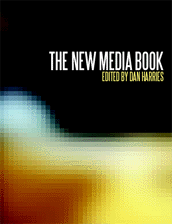
Edited by Dan Harries
London: bfi Publishing, 2002 Preface
The term 'new media' has become an effective catch-word both as a description of the digital
delivery of media via the Internet, DVD, and digital television and as a reference to the
'newness' such technologies have brought to media more generally. But what makes new
media 'new'? Is it the new ways in which we interact with media? Is it the new convergences
(and bundling) of media technologies? Or is it the increasing interdependence (and
overlap) of various media products? In short, the answer is that the 'newness' of new media
can be attributed to all of these factors and more.
The interaction, augmentation, and interdependence arising between what can be
roughly deemed as 'old' media and 'new' media producers are some of the most prominent
aspects of contemporary media. Films are now modelled after successful computer
games, Web sites are leveraging popular television programmes, and DVD titles are combining
movies with a host of digitised paraphernalia. While movie 'tie-ins' may not be a new
phenomenon, the lines between the original and the 'tied' text are becoming blurred as one
text may be produced simultaneously and equally across various platforms. This synergistic
relationship amongst media has become a necessary feature within the new media
market paradigms and the growing global production and marketing ecologies. Traditional
media producers are keeping a cautious finger in the digital media pie, while new media
producers are more than eager to bring on-board traditional entertainment brands, titles,
and talent.
Similarly, changes in media distribution and consumption are evident on a number of
fronts. Hollywood studios and national television networks have actively expanded the
reach of their products by simply 'inserting' their movies and television programmes into a
digital platform, such as the viewing of material on the Internet or the production of feature
film DVDs. Others have attempted to create new and innovative ways to make the viewer
a more interactive participant in the viewing process. Venues for media exhibition are also
changing with e-cinema and Video-on-Demand now competing with more traditional
modes of exhibition such as the cinema or broadcast television. Such shifts signal the return
of vertical integration within Hollywood, as well as the move to horizontally-leverage products
across the media spectrumÑall in the name of creating the next successful 'integrated
media experience'.
Since the early 1990s, many of us teaching and researching in the areas of film, media,
and communication studies have been both bemused and intrigued by the potentialities
and eventual realities of new media (also referred to by a variety of terms including multimedia,
interactive media, online media, and digital media). We began to modify existing
media courses, as well as to devise specific courses, to consider new and emerging forms
of media. At the same time, scholars expanded their existing research areas to investigate
the relationships between 'new' and 'old' media.
This book brings together many of these scholars, from a variety of academic disciplines
including film, media, and communication studies, to document, analyse, and forecast the
shifting parameters of the 'new' media. These scholars share the view that these developments
have arisen not out of some sort of cultural, historical, or technological vacuum, but
instead have developed within and have been conditioned, pre-empted, and influenced by
a broader context and array of existing media technologies, production strategies, narratives,
aesthetics, spectatorships, and patterns of consumption.
The book is divided into five sections that represent areas of analysis typically conducted
in the study of media: Technologies, Production, Texts, Consumption, and Contexts. Of
course, the very nature of new media makes such division into discreet sections a fairly dif-
ficult task, and while each chapter makes a solid contribution to its designated section,
each chapter also makes pertinent connections across the sections and highlights the
dynamic and fluid nature of the 'new' media.